
Guide to the 30% Ruling
The 30% ruling is intended to make it easier for employees you attract from abroad to move to the Netherlands. The first 30% of their gross salary is not taxed in the Netherlands in the first five years of their stay, so the net salary is higher than without the scheme. The main eligibility requirements are:
- An annually changing minimum fiscal annual wage.
- Employee was recruited from abroad and will be employed by a Dutch employer.
- Employee lived more than 150 kilometers away from the Dutch border in 16 out of 24 months prior to employment in the Netherlands
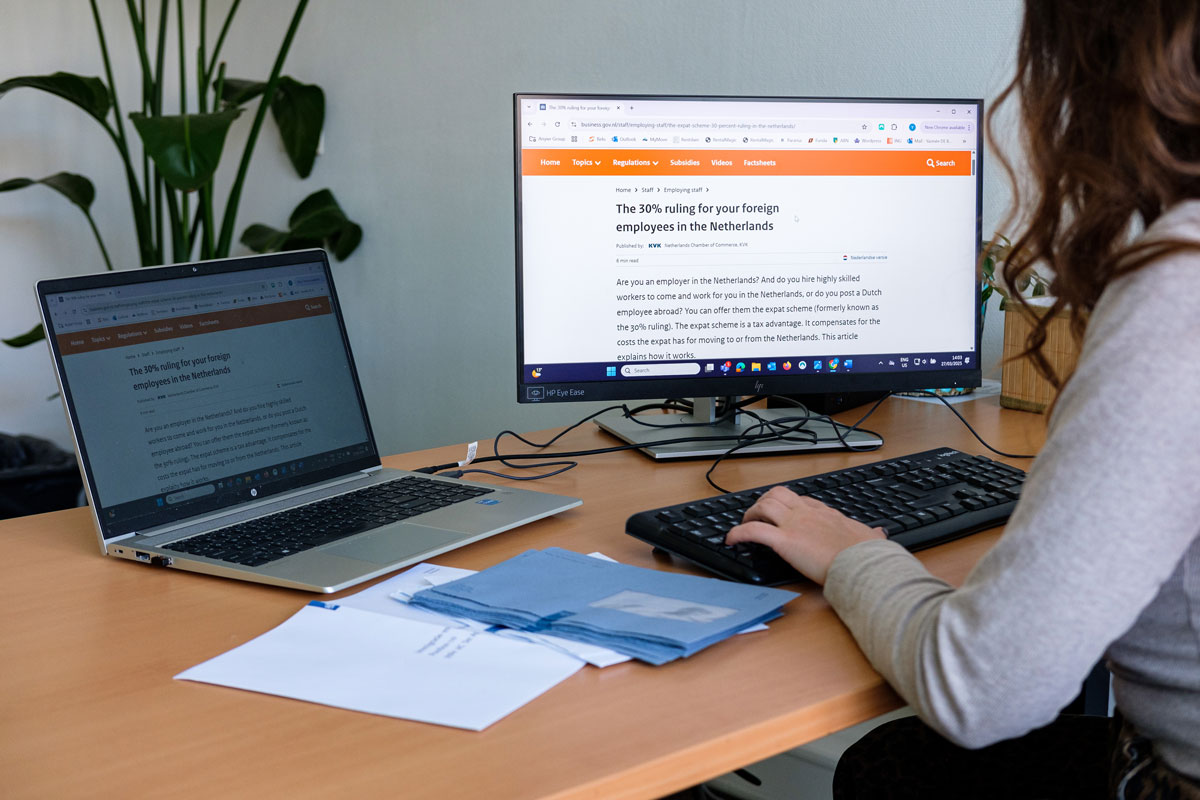

What is the 30% ruling?
The 30% ruling is intended to give your international employees, whether they are expats or hired on a local contract, an allowance for the extra costs they incur when they move to the Netherlands. For example, you should think of a house that your employee keeps in the country of origin, or the extra travel costs that a foreign employee incurs to visit family.
Terms & Eligibility
- A valid decision (or until you have received it the decision of a covenant holder, such as Anywr Netherlands).
- Expertise in the Dutch labour market, as evidenced by an annually changing minimum annual taxable wage:
- Applications for employees aged 30+ in 2026: € 48 013.
- Employees < 30 years of age with a recognised master’s degree: € 36 497. Please note: when the employee turns 30, the 30+ salary requirement must be met!
- These standards do not apply to scientific researchers or doctors in training.
- Employee was recruited from abroad or sent to the Netherlands.
- The employee is on the payroll of a Dutch employer.
- Employee lived more than 150 kilometers away from the Dutch border in 16 out of 24 months prior to the first working day in the Netherlands.


Calculation examples
The taxable annual salary after application of the 30% ruling must be at least equal to the test salary for full application of the scheme. You calculate the test salary by taking it 70% of the annual salary (100-30%). Partial application of the scheme is also possible, as long as the test salary exceeds the annual requirement. A few examples:
- Your employee over the 30 years has an annual taxable salary of € 100 000. The qualifying salary is € 100 000 * 0.7 = € 70 000. You can make use of the full 30% rule if the other conditions are also met.
– Your employee over the 30 years has an annual taxable salary of € 80 000. The qualifying salary is € 80 000 * 0.7 = € 56 000, which makes the employee eligible for partial application of the scheme: € 56 000-€ 48 013 = € 7 987 = 8%. (the other conditions also have to be met!)
– YYour employee over the 30 years has an annual taxable salary of €50,000. The qualifying salary is € 50 000 * 0.7 = € 35 000. The employee is not eligible for the scheme because the qualifying salary is lower than the requirement (2026: € 48 013).
The 30% ruling will become 27% in 2027
The current 30% ruling is in force until 2027. If your employee is eligible, it means that the first 30% of the salary is not taxed. In principle, the scheme applies for 5 years, regardless of the employment contract you enter into with the employee. It is important to know that the percentage of the scheme will go to 27% by 2027. This also applies to current 30% rulings from 1 January 2024. Schemes approved until 31 December 2023 will remain at 30% for the full 5 years.


Why apply for the 30% ruling?
The 30% ruling makes it attractive for your future employee to move to the Netherlands for your company, or to switch in the Netherlands. This gives your company an advantage on the labor market.
Even if your employee is only eligible for the scheme to a very limited extent, this can still offer a major advantage. After all, the employee can get a promotion, or otherwise receive a higher salary. Then the advantage increases. If you did not apply because of a too small benefit in your eyes, this can be really disadvantageous later on.
What 30% ruling categories are there?
- For regular employees
- Older than 30 years
- Younger than 30 years with a Master’s degree obtained in the Netherlands (special conditions apply regarding their residency!), or at a recognized foreign university
- For PhD students and scientific researchers
- For doctors in training

Advantages and disadvantages of the 30% ruling
Advantages
- Higher net salary for your employee.
- Lower tax burden for your company.
- Good for your image as an employer on the international labour market.


Disadvantages
The taxable salary will be lower by applying the 30% ruling. This has consequences for your employee:
- Possible unemployment/sickness benefits.
- The pension accrual.
- The amount your employee can borrow for a mortgage.
- Tax refunds if your employee owns a home.
The application process in 5 steps
You can apply for 30% together with your employee, or you can ask Anywr Netherlands to do so.


Obligations
- Your company is obliged to meet the required annual salary of the employee.
- The employee remains employed by the Dutch employer.
- You may only apply the scheme with a valid decision.
- You keep your payroll records and the decision of the Tax and Customs Administration regarding the 30% ruling for 7 years after the employee’s termination of employment.
Penalties for non-compliance with obligations
If your company does not meet the requirements, the Tax and Customs Administration can impose a correction obligation. This means that you must rectify the situation, or that you may not apply the 30% ruling (possibly with retroactive effect). In this case, you will have to adjust the employee’s salary, or reclaim the overpayment.


Validity and controls
The 30% ruling is valid for 5 years. If it was issued before 31 December 2023, the percentage will remain at 30% for those 5 years. If the issue date is after 1 January 2024, the percentage will go to 27% by 2027.
The Tax and Customs Administration actively monitors the correct application of the 30% ruling.
As a covenant holder since 2012, Anywr Netherlands makes decisions on behalf of the Tax and Customs Administration. You will receive our decisions, that you can implement in your wage administration with immediate effect. Our decisions are checked randomly and several times a year. We have always passed these checks well. However, if errors are found, we will take this up with you.
How Anywr helps
The 30% ruling seems simple, but it is not. If you make mistakes with the application, you risk very unpleasant situations with your employee. Correcting salary payments is something you probably prefer to avoid!
Anywr Netherlands assists with hundreds of applications per year, so that our expertise is always up to date. Anywr Netherlands has a covenant with the Tax and Customs Administration, which authorizes us to make decisions on their behalf. That quickly saves 6-7 weeks per request!
Our latest news

The immigration options for US citizens who want to relocate to the Netherlands
Turning the Dutch Dream into Reality: A US Citizen’s Guide to Relocating For many Americans,…

2026 municipal elections in the Netherlands for residents with a foreign passport
On 18 March 2026, municipal elections will be held in the Netherlands. Voters across 333…

A new government in the Netherlands – impact on companies working with highly skilled migrants
This morning, the Netherlands officially welcomed its new government: the Jetten administration. A new government…